
Resources
Discover lay-friendly resources about Aquaculture in the Southeast United States! Our curated database includes resources for the general public, seafood lovers, educators, extension personnel, and folks in the service industry.
Search Results
Filters

Understanding the Details of a Shrimp Label
his video explains how to read shrimp labels when purchasing seafood in the United States. It discusses country of origin labeling, wild‑caught versus farm‑raised shrimp, size counts, common post‑harvest treatments, and packaging types. The video helps consumers understand how shrimp are sourced, processed, and presented at retail counters.

Stay for the Seafood – Lake Charles, Louisiana
This video features Lake Charles chef Lyle Broussard of Food & Brews preparing a signature dish using fresh, wild‑caught Louisiana seafood. Viewers learn what makes Louisiana‑harvested seafood distinctive, how chefs work directly with local fishermen, and why supporting locally sourced seafood strengthens coastal food traditions and working waterfronts.

Shrimp on the Prairie and Aquaculture Comics
This NOAA Sea Grant resource features educational comics that explain coastal, ocean, and water‑related topics through visual storytelling. The comics, including the Our New Age of Water series, explore current and future challenges such as aquaculture, sea level rise, and ocean chemistry, and are designed to support science literacy and public understanding.

Invertebrate Diversity Lesson
This K–5 lesson explores marine invertebrate diversity through classification, microscopy, and scientific illustration. Students distinguish micro‑ and macroinvertebrates, use microscopes to observe microscopic organisms, classify marine invertebrates by phylum, and create detailed scientific drawings. The lesson emphasizes observation, biodiversity, adaptations, and evidence‑based reasoning in scientific investigations.

Sustainable Seafood Choices with Sarah Curry
This recorded webinar features Sarah Curry, founder of Sereia Films, presenting an educational overview of how seafood choices affect ocean health. Hosted by the Marine Environmental Education Center in Florida, the talk explores wild‑caught and farmed seafood, fisheries management, aquaculture practices, consumer decision‑making, and practical ways individuals can support sustainable oceans through informed seafood choices.

Water Quality Lesson
This K–5 lesson introduces students to water quality through hands‑on testing, data collection, and modeling. Students use water test kits to analyze samples, simulate the aquarium nitrogen cycle with a movement activity, evaluate water health, and create watercolor artwork depicting clean and polluted water. The lesson integrates chemistry, ecology, observation, and scientific reasoning.

Waters to the Sea: Gulf Coast Adventure
This interactive learning program from Hamline University’s Center for Global Environmental Education takes learners on a multimedia journey across the U.S. Gulf Coast. Through videos, virtual panoramas, and interactive modules, it connects watersheds to estuaries and coastal ecosystems, helping students understand how land‑use decisions affect the health of Gulf waters and communities.

Mollusk Science Lesson (including squid dissection)
This grades 6–12 lesson explores mollusk diversity through classification, shell identification, and hands‑on squid investigation. Students examine characteristics of major invertebrate phyla, classify seashells, dissect a squid to study external and internal anatomy, and create artwork using squid ink. The lesson integrates biology, anatomy, data collection, and connections between science and art.

Education on the Halfshell: Using Oysters to Teach Biological Concepts
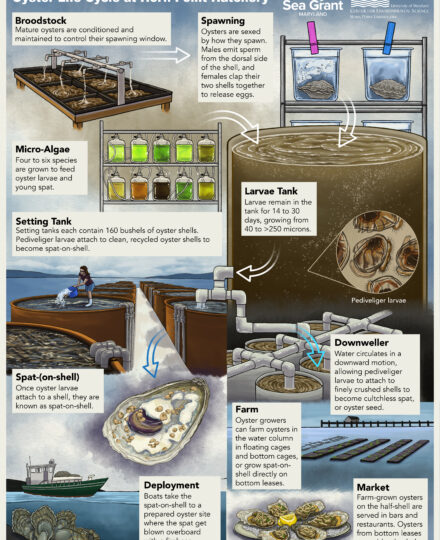
Education on the Halfshell is a Louisiana Sea Grant educational resource that uses oysters to teach biological and ecological concepts. The teacher‑developed lesson plans introduce students to oyster biology, shell identification, and aquaculture while emphasizing oysters as indicators of estuary health and their role in coastal ecosystems and Louisiana’s seafood industry.
Disclaimer: The content contained herein is for informational purposes only. The Southeast Aquaculture Communications Collaborative does not endorse the content and does not guarantee the accuracy, completeness, or usefulness of the information. The Southeast Aquaculture Communications Collaborative does not accept liability for any injuries or damages caused by those acting upon or using the content contained on this website.